Learn how AI agents, data integration, and governed workflows help life sciences teams improve drug discovery, reduce research friction, and support better R&D decisions.
May 6, 2026
James Alvord

Drug discovery has more data, more tools, and more computational power than ever. Yet Life Sciences teams still face high development costs, long timelines, fragmented workflows, compliance pressure, and limited visibility across research operations.

Following Stacey Fernandes’ participation in the SIM Boston Life Sciences CIO Roundtable, four themes stood out:

  • Drug discovery needs stronger target validation earlier.
  • Data integration remains a major R&D bottleneck.
  • AI agents need trusted tools, governed data, and defined workflows.
  • Collaborative AI needs human oversight, transparency, and control.

Together, these themes point to a practical future for AI in life sciences. AI should not replace scientists, bypass governance, or become another disconnected tool. It should support better research decisions, stronger workflow consistency, and faster access to trusted insight.

The Attrition Problem
Drug Discovery Needs Better Validation Earlier

Drug development takes over a decade and billions of dollars. Even after years of work and investment, about 90% of candidates fail due to efficacy or safety issues.

For life sciences leaders, this creates pressure to improve validation earlier in the process. The issue is not only speed. It is signal quality.

Research teams need stronger ways to connect data across functional genomics, translational research, clinical medicine, lab operations, scientific literature, and experimental evidence.

When this data remains fragmented, teams lose early visibility. Patterns stay hidden. Assumptions move forward unchecked. Risk builds until later stages, when failure becomes more expensive.

Earlier validation helps teams pressure-test scientific direction before time, capital, and patient opportunity get committed to one path.

AI has a role in this work, but it does not fix weak data foundations on its own. It needs trusted data, clear workflow structure, traceable reasoning, and scientific review.

The Integration Bottleneck
More Data Does Not Mean Better Decisions

Life sciences organizations do not lack data. They lack connected, trusted, usable data.

Research, clinical, regulatory, and operational data often sit across different systems, teams, and workflows. The result is friction. Teams spend time reconciling sources, repeating analysis, searching for context, and questioning which source to trust.

The scale of biological data adds another layer of complexity. Integration is not only technical. It also involves governance, auditability, access control, workflow alignment, data ownership, cross-functional accountability, and compliance requirements.

This matters even more when AI enters the workflow. AI systems need clean access to trusted sources, defined boundaries, reviewable steps, and audit paths. Without this structure, AI creates more work instead of better decisions.

For example, an AI supported research workflow might pull from genomics data, clinical context, internal research notes, external literature, and regulatory documentation. If those sources lack alignment, AI output becomes harder to trust. The team still needs to verify sources, resolve conflicts, and document decisions.

So the bottleneck moves. It does not disappear.

Strong integration gives AI a better operating environment. It also gives scientists, data leaders, IT teams, and compliance stakeholders a shared foundation for review.

Data integration is not plumbing. It is the base layer for governed R&D.

The AI Agent Solution

Better Systems Around the Model

Large language models become more useful in life sciences when paired with specialized tools, trusted data sources, and defined workflows. The model alone is not the strategy. The operating system around the model matters.

AI agents help support complex, multi-step research tasks by working within structured processes. They help teams:

  • Search trusted sources
  • Compare findings
  • Summarize evidence
  • Follow defined workflows
  • Document reasoning paths
  • Support decision-making

This does not replace scientists. It supports them.
The near-term value sits in productivity, consistency, and decision support. For example, an AI agent connected to approved bioinformatics tools and governed datasets might help a research team review known pathways, compare evidence, summarize findings, and flag gaps for expert review.

The scientist still decides. The workflow becomes more consistent. The review path becomes clearer. The team gains speed without losing control.

In life sciences, useful AI is not the loudest model. It is the system built around trusted data, workflow discipline, clear permissions, scientific oversight, reviewable output, documented decisions, and compliance alignment.

AI agents create value when they fit into how research work happens. They create risk when teams treat them as standalone answer machines.

Collaborative AI

Multiagent Systems Need Human Oversight

The future of AI in life sciences is not one model doing everything. It is specialized agents working together under human oversight.

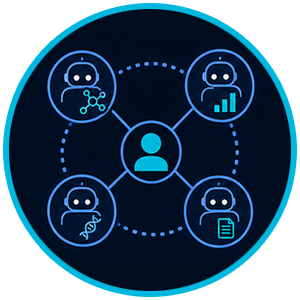
A multiagent system might include one agent for data retrieval, another for literature review, another for pathway comparison, another for workflow documentation, and another for compliance support. Each agent supports a specific task. Together, they help reduce friction across research workflows.

Used with discipline, collaborative AI helps teams connect data across functions, reduce manual coordination, improve consistency, support research tasks, preserve review points, strengthen documentation, and keep humans in control.

The human role stays central. Scientists need visibility into how conclusions form. Data leaders need confidence in source quality. IT teams need control over access, security, and system behavior.

Compliance teams need auditability. Executives need clarity around risk, value, and governance.

For regulated life sciences teams, governance is not a finishing touch. It needs to sit inside the workflow from the start.

A Practical Path Forward

AI in drug discovery is not only a model selection issue. It is a data, workflow, governance, and operating model issue.

Before scaling AI agents across R&D, life sciences leaders should ask:

  • Which data sources are trusted?
  • Which workflows create the most friction?
  • Where does human review occur?
  • Who owns governance?
  • How will decisions get documented?
  • Which systems need integration?
  • How will auditability work?
  • Which use cases create measurable value?

Life sciences organizations do not need sweeping transformation on day one. They need focused use cases tied to real operating friction.

Start with one high-value research workflow. Map the data sources involved. Identify trusted systems of record. Define user roles and access rules. Document human review points. Establish audit paths. Test AI agent support in a controlled setting. Measure productivity, consistency, and decision quality.

AI agents hold promise for life sciences, but the strongest results will not come from speed alone. They will come from better validation, stronger integration, governed workflows, and human oversight.

That is how life sciences teams move faster while protecting trust, compliance, and scientific rigor.

Learn how Versetal can help you with your IT Ops